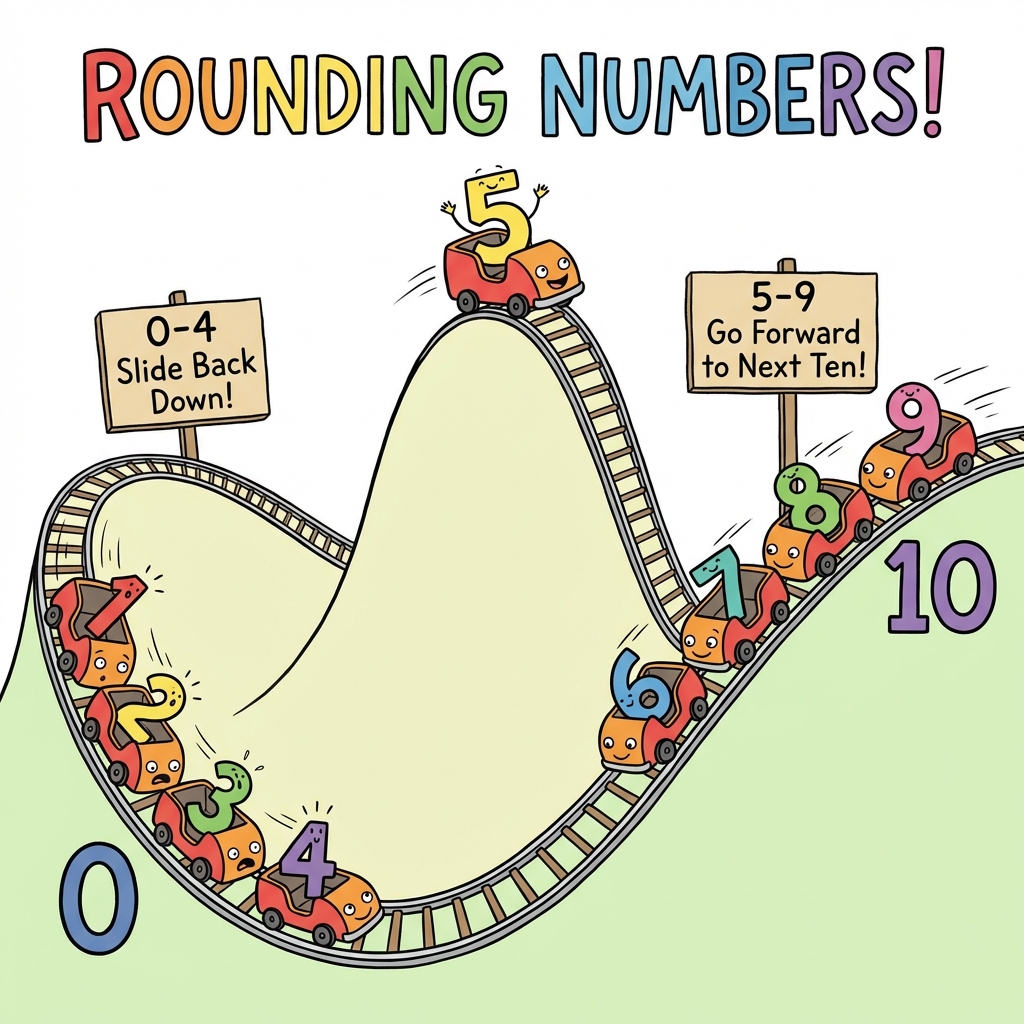
Rounding & Estimation
Simplifying numbers for quick mental math.
Core Concepts
Rounding means replacing a number with an approximate value that has a shorter, simpler, or more explicit representation.Estimation is finding a number that is close enough to the right answer.
The Rounding Rule
Look at the digit to the right of the place you are rounding to:
• 0, 1, 2, 3, 4: Round DOWN (Keep the digit same).
• 5, 6, 7, 8, 9: Round UP (Add 1 to the digit).
Why Estimate?
Estimation helps you check if your answer makes sense.
Example: If you buy items for $19 and $22, you can estimate the total is about $20 + $20 = $40.
Solved Examples
Example 1: Rounding to Nearest 10
Question: Round 34 to the nearest 10.
• Step 1: Identify the Tens digit (3).
• Step 2: Look at the neighbor to the right (4).
• Step 3: Since 4 is less than 5, we round DOWN.
• Answer: 30.
Example 2: Rounding Up
Question: Round 68 to the nearest 10.
• Step 1: Tens digit is 6.
• Step 2: Neighbor is 8.
• Step 3: Since 8 is 5 or more, we round UP.
• Answer: 70.
Example 3: Rounding to Nearest 100
Question: Round 250 to the nearest 100.
• Step 1: Hundreds digit is 2.
• Step 2: Neighbor (Tens place) is 5.
• Step 3: The rule says 5 rounds UP.
• Answer: 300.
Example 4: Estimating a Sum
Question: Estimate the sum of 29 + 42.
• Step 1: Round each number to the nearest 10.
• 29 becomes 30.
• 42 becomes 40.
• Step 2: Add the rounded numbers.
• 30 + 40 = 70.
• Answer: Approximately 70.