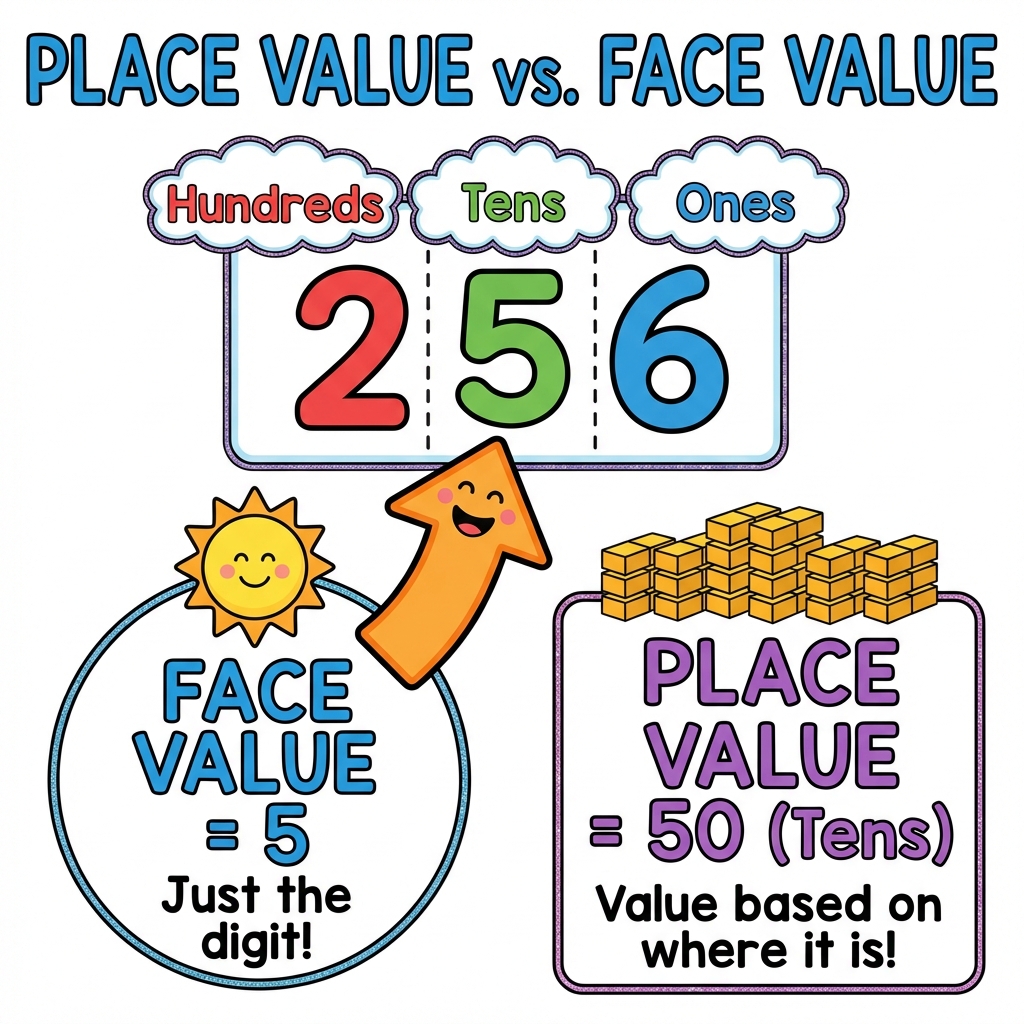
Place Value & Face Value
Understanding the core structure of numbers.
Core Concepts
In mathematics, every digit in a number has two values: its Face Value and its Place Value. Understanding the difference is crucial for all arithmetic operations.
1. Face Value
The Face Value of a digit is simply the digit itself. It does not depend on where the digit is located in the number.
Example: In the number 582, the Face Value of 5 is just 5.
2. Place Value
The Place Value of a digit depends on its position (Ones, Tens, Hundreds, etc.). It is calculated as:
Place Value = Face Value × Position Value
Example: In 582, the 5 is in the Hundreds place, so its Place Value is 5 × 100 = 500.
Solved Examples
Example 1: Analyzing a 2-Digit Number
Question: Find the Place Value and Face Value of 6 in the number 63.
• The digit is 6.
• Face Value: It is simply 6.
• Position: The 6 is in the Tens place.
• Place Value: 6 × 10 = 60.
Example 2: The Role of Zero
Question: Find the Place Value of 0 in 509.
• The digit is 0.
• Face Value: 0.
• Position: Tens place.
• Place Value: 0 × 10 = 0.
Note: The Place Value of 0 is always 0, no matter where it is!
Example 3: Large Numbers
Question: What is the Place Value of 4 in 4,215?
• The digit is 4.
• Position: Thousands place.
• Place Value: 4 × 1000 = 4,000.
Example 4: Comparing PV and FV
Question: Find the difference between Place Value and Face Value of 3 in 35.
• Place Value (PV): 3 is in Tens place → 30.
• Face Value (FV): The digit is 3.
• Difference: PV - FV = 30 - 3 = 27.