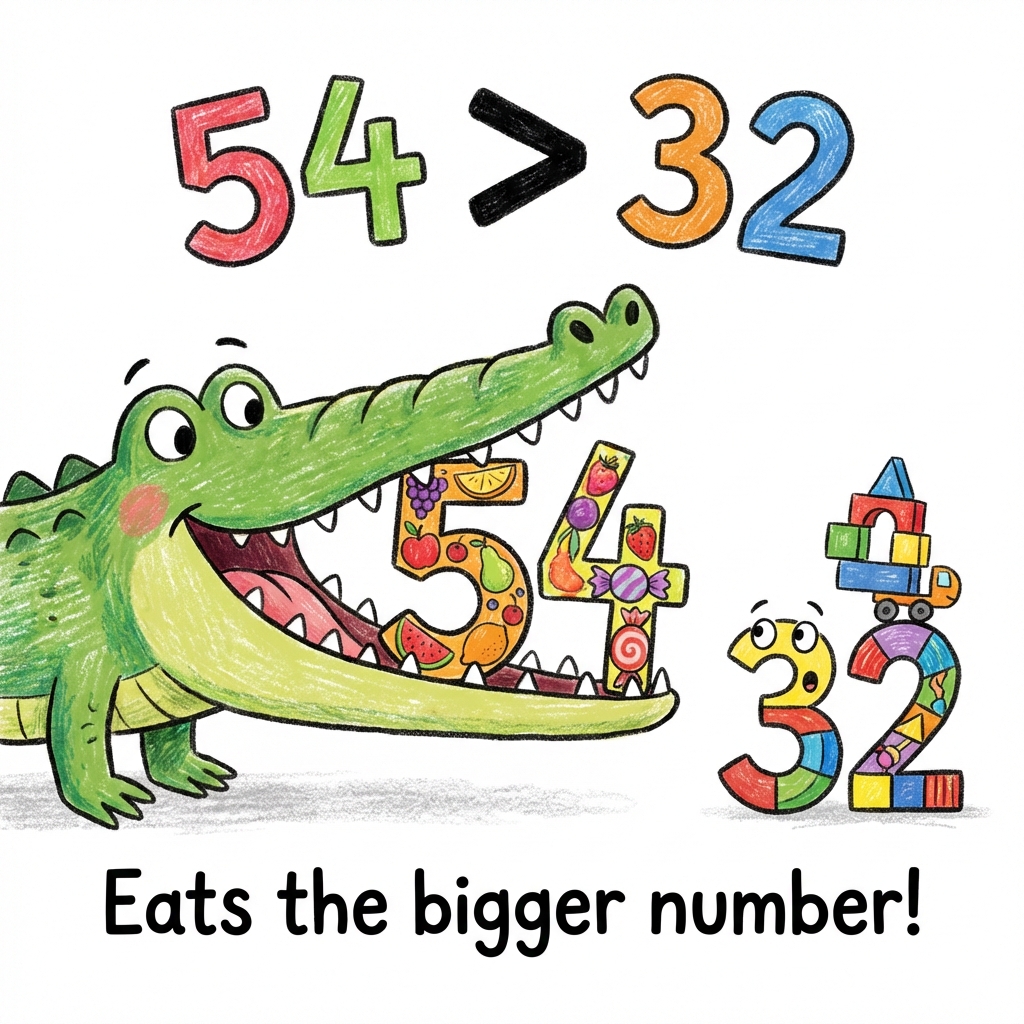
Comparing Numbers
Mastering Greater Than, Less Than, and Equal To.
Core Concepts
Comparing numbers allows us to determine which number represents a larger quantity. We use three main symbols for this:
- > (Greater Than): The open side faces the larger number. (e.g., 5 > 2)
- < (Less Than): The closed point faces the smaller number. (e.g., 2 < 5)
- = (Equal To): Both numbers are exactly the same. (e.g., 5 = 5)
The Golden Rules of Comparison
- Count the Digits: The number with more digits is always greater. (e.g., 100 > 99)
- Compare Left to Right: If the number of digits is the same, compare the digits starting from the left (highest place value). The first digit that is different decides which number is larger.
Solved Examples
Example 1: Different Number of Digits
Question: Compare 98 and 102.
• Step 1: Count the digits.
• 98 has 2 digits.
• 102 has 3 digits.
• Conclusion: Since 3 digits > 2 digits, 102 is greater.
• Answer: 102 > 98 (or 98 < 102).
Example 2: Same Number of Digits
Question: Compare 452 and 439.
• Step 1: Count digits. Both have 3 digits.
• Step 2: Compare the Hundreds place. Both have 4. (Equal)
• Step 3: Compare the Tens place. 5 vs 3.
• Conclusion: Since 5 > 3, the first number is larger.
• Answer: 452 > 439.
Example 3: Close Call
Question: Compare 7,890 and 7,895.
• Step 1: Compare Thousands. 7 vs 7. (Same)
• Step 2: Compare Hundreds. 8 vs 8. (Same)
• Step 3: Compare Tens. 9 vs 9. (Same)
• Step 4: Compare Ones. 0 vs 5.
• Conclusion: 0 < 5, so the second number is larger.
• Answer: 7,890 < 7,895.
Example 4: Leading Zeros
Question: Compare 050 and 50.
• Insight: A zero at the very start of a whole number does not add value.
• 050 is the same as 50.
• Answer: 050 = 50.